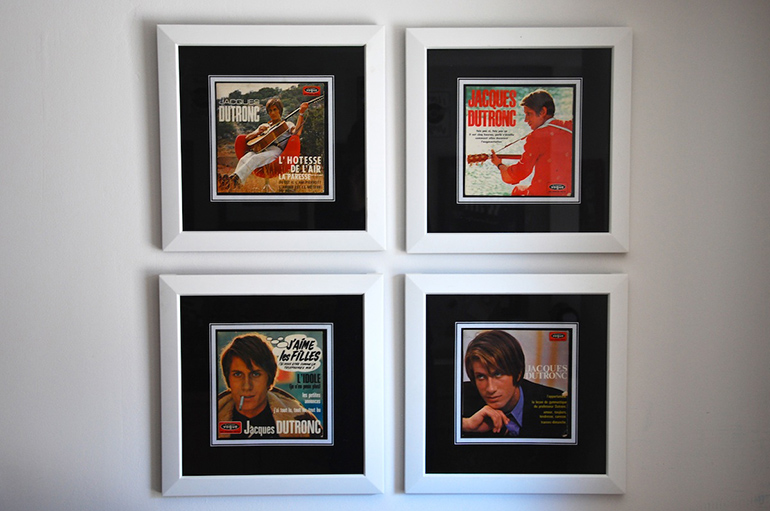
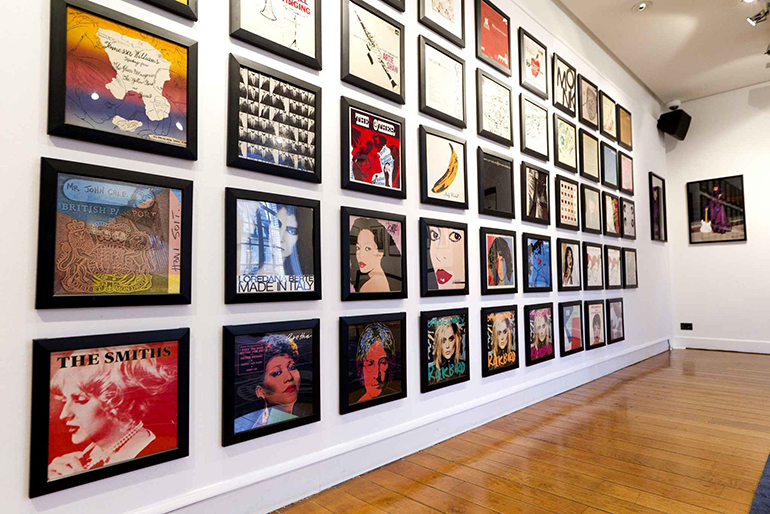
Framing your vinyl records might seem brilliant to some and quirky, even heretical, to others. At Rock on Wall, we have resolutely chosen the former, to the point of making it our profession. The history of music and its most popular medium, the vinyl record, has graced us with hundreds of thousands of album covers since 1958, and it would be criminal not to exploit this decorative potential. So here is a guide to rediscovering your collection from a new perspective, that of the large-format album cover.
From Johnny to Eddy in a few seconds
Let's first address a few objections. Putting a vinyl record in a frame does not mean you can no longer listen to it or are condemned to only admire that particular one. Unlike the coasters from a certain Swedish giant, the Rock on Wall frame allows you to place and remove the record with a single gesture and without disassembly! So you can take it out at any time to listen to it, and switch from the Rolling Stones to the Beatles (or from Johnny to Eddy) in a few seconds. The record is also protected from dust and humidity and only fears intensive UV exposure, which should be taken into account when choosing its location.

A solution for every format... or almost
Our frame was initially designed for LPs and 12-inch singles up to 10 mm thick. It is therefore compatible with single, double, and triple albums not exceeding this limit. Some maxis without an inner sleeve are slightly smaller, and should be accompanied by a neutral backing to prevent a gap between the frame and the cover. For 7-inch singles and picture discs, we have developed a support pompously called universal, which allows them to be perfectly centered within the frame. Ultimately, the only formats that do not fit into the Rock on Wall frame are 10-inch records and quadruple albums. You also cannot display "gatefold" sleeves in their full format, but if the front and back covers complement each other, you can simply display them side by side (and own a duplicate of the record, of course).

Decorating with vinyl records, okay, but which ones?
With an almost inexhaustible graphic source, the only limits to this principle are your imagination. Here are a few ideas, from the simplest to the most sophisticated, to help you get started:
-
The one and only:
Are you a fan of Johnny, The Smiths, Led Zep, or Coltrane? Make a statement by displaying 2 or 3 iconic album covers in the entryway or above your turntable. -
The complete works:
Do you sleep in Eddy Cochran briefs or drink your coffee from a Rolling Stones mug, and for you it's all or nothing? No problem, dedicate the main wall of the living room, the stairwell, or the "music room" to the glory of your musical hero, depending on the available space and your significant other's mood. -
The format salad:
Maxi-singles and 7-inch singles often share a common design with the album they come from; it's always interesting to group them together to tell the whole story. In some cases, you can also combine outer and inner sleeves or front and back covers. -
Grunge, Reggae or Prog Rock:
Combining several artists from your favorite musical genre is a way to announce to visitors that here, things are taken seriously, and they better brush up for next time. -
The label of your dreams:
Blue Note, Factory, 4AD... many labels have made album covers their signature. Combining Coltrane and Thelonious Monk, New Order and Orchestral Manoeuvres in the Dark, The Pixies and Cocteau Twins, what a beautiful way to tell the story of your music. -
Superstar graphic designers:
Some artists have made their mark on the history of album covers; collecting their creations is a fascinating treasure hunt that can quickly turn into an obsession! -
Strong on themes:
Colors, animals, sports, seasons, transportation, drinks, cities, clothes: there is no theme that the vinyl record cover has not explored. An opportunity to challenge yourself in more or less difficult but terribly enjoyable ways. -
The exhibition:
If your name is Philippe Thyere or Radio France, you are called upon to adorn spaces of a whole different dimension: between 150 and 200 album covers were needed for the Psychedelism, Inside Vinyl, or The Voice of Our Masters exhibitions!
Masters of the genre
Several famous graphic designers have elevated the art of the vinyl record cover. For the price of a banana and a zipper, Andy Warhol became its undisputed master. But we can also mention Peter Saville at Factory, Vaughan Oliver at 4AD, Roger Dean (designer of Yes band covers), the cartoonist Serge Clerc, Hans Giger and his fantastic universe... And then there are the unknown soldiers who deserve respect. For example, take a look at the magnificent children's record covers made by a certain Denise Chabot; it's impossible not to fall under their charm.

Some final tips
- Buy French: there are many vinyl record frames on the market, but only the Rock on Wall frame brings together components manufactured in Thônes, Lyon, Cran-Gevrier, and assembled in Grenoble!
- Hunt for treasures: flea markets are full of abandoned vinyl records just waiting for your keen eye to shine again.
- Whatever the number of framed records, group them together for a more impactful display.
- Leave the record inside the sleeve; you'll avoid damaging or misplacing it, and framing will be easier.
- Play with the rooms of the house: children's records in the kids' bedroom, classical above the piano, Cerrone's Paradise next to the fridge...